

Advanced
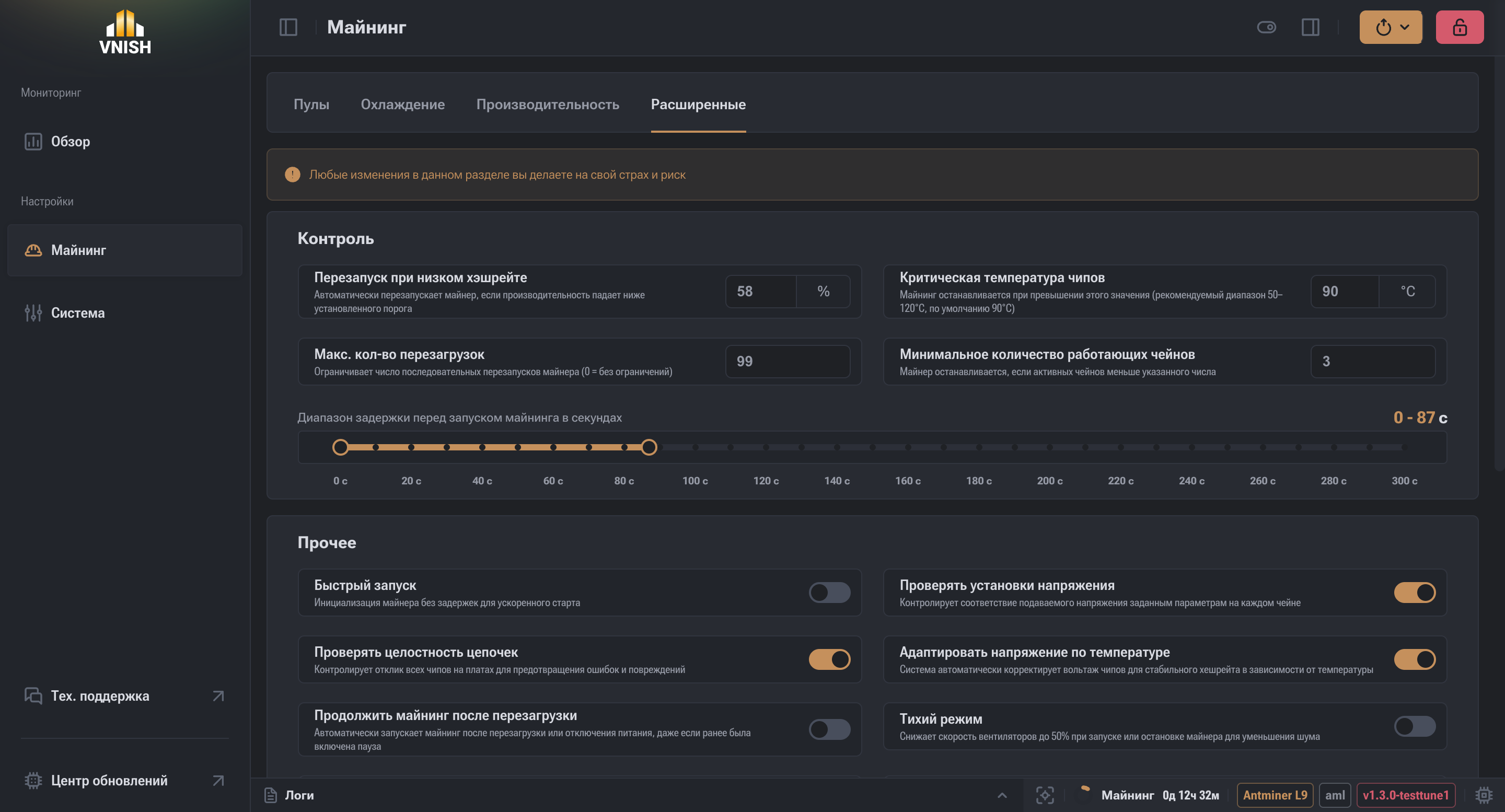
This section contains low-level system parameters responsible for hardware protection, failure logic, and automation of recovery processes.
Warning: Any changes in this section are made by the user at their own risk.
Control

This function automatically restarts the mining process if the device's current performance drops below a set threshold.
Description and Configuration
The user sets a minimum performance threshold in the range of 0% to 99%, where 0 disables this function. The system compares the actual Hashrate with the nominal (theoretical) value.
Theoretical Hashrate Calculation The system compares actual performance with a theoretical value, calculated using the formula: Theoretical Hashrate = (Chip Frequency × Number of Cores) / 1000
Where:
- Chip Frequency — current operating frequency;
- Number of Cores — total number of computational cores in the device.
If the current Hashrate drops below the specified percentage of the nominal value, the system initiates a miner restart.
Algorithm and Timing Cycles for Checking
Hashrate checks are performed according to the following timing rules:
- Initial Delay: The check starts no earlier than 5 minutes after mining begins, and for a fast start, after 10 minutes (for stabilization of indicators).
- Exclusion: The setting is not active during a preset change or within the first 5 minutes after startup. If less than 3 minutes have passed since startup, the check is also not performed. It does not work during Autotune.
- Periodicity: After the initial stages, the system checks the Hashrate against the set threshold every 90 seconds.

Limits the number of consecutive system restart attempts in case of errors.
Restart Conditions
The system's reaction depends on this parameter's settings:
- Limited Attempts: The miner will restart as many times as specified in this field.
- Infinite Cycle: If set to 0, the number of restarts is unlimited (checking and restarting will be performed cyclically until performance is restored).

Temperature limit (recommended range 50–120°C, default 90°C). When reached, mining stops to prevent chip damage.
Overheat Protection Description
Regardless of the temperature set in this field, if the maximum temperature on the miner exceeds this value, the system will immediately shut down. This is the primary overheat protection.
The following rules are used to determine when protection is triggered:
- Data Source: The system relies on the temperature of the hottest chip or the hottest sensor (if chip temperature measurement is unavailable).

Stops the device if the number of active hash boards (chains) falls below a specified number.
Operation Logic and Checks
The system checks the operability of each chain (board) regardless of whether it is enabled or disabled in the settings. The check determines if all chips on the board are detected.
Example of operation:
- If a miner has 4 chains installed and the value 4 is specified in this field, then if at least one chain fails (leaving only 3 working), the miner will not start.
- If in the same situation the value 3 is specified, the miner will start and continue operating on the three working boards.

A slider to set the waiting time (from 0 to 300 seconds) before mining begins after the device is turned on. This is necessary for power stabilization and initialization of all systems.
Randomization Logic and Network Load
The user selects a time range, for example, from 160 to 200 seconds. The system automatically selects a random value within this interval for each specific device.
This time is used as a pause before the initialization of all equipment begins and affects the start mining and resume mining processes.
Principle of operation:
- If a waiting time is set, the miner will simply wait for this period to complete before starting the initialization of the power supply unit and other components.
- Thanks to randomization, the delay on one miner might be 160 seconds, while on another it could be 200 seconds.
- This helps avoid instantaneous peak load on the electrical grid, ensuring smooth equipment startup and preventing sudden voltage spikes.
Other

Accelerated miner initialization without performing some checks.
Function Description and Effectiveness
Initialization occurs significantly faster by disabling all delays. The function allows the miner to be turned on as quickly as possible to create a load on the equipment.
Operation features on different models: Although the function is available on all devices, its effectiveness depends on the miner's hardware features:
- On some models, only one sensor operates during the initialization phase, and the system needs time to determine the required cooling level.
- For example, on the S21 Pro model, the cooling phase is fixed at 120 seconds, so using fast start on this device does not yield a visible effect.
How to determine the advisability of use: To understand if fast start works on your device, pay attention to the logs during startup:
- If the Temperatures 38 - 41 C line shows a cooling process with a temperature difference (e.g., 6, 5 degrees) and the miner continues initialization — fast start will be effective.
- If you see a cooling countdown (120 seconds, 110, 100, etc.), then using fast start is pointless, as the delay is built into the operating algorithm of this model.

Monitors the uniform distribution of voltage and the stability of chip operation within domains.
Operation Logic and Hashrate Recovery
The function checks the performance within each voltage domain. If the Hashrate of the entire domain becomes unstable and drops below 50% of the nominal (calculated based on the current frequency), the system attempts to stabilize the chips for that chain.
Stabilization under changing conditions: The function is useful in situations where external operating conditions change. For example, if the room where the miners are located first became colder and then warmed up again, the chips might start working unstably. In such cases, they often cannot restore normal operation on their own. The miner performs a forced restart of the chips to stabilize the Hashrate, if technically possible under current conditions.
Conditions and Limitations
This option has several operational limitations:
- When the function does NOT work:
- If the Autotune process is enabled (Autotune).
- If the miner has not yet fully initialized.
- When changing a preset.
- If the miner is not in an active mining state.
- If less than 2 minutes have passed since mining started.
- Check Periodicity:
- After operation stabilizes, the domain balancing check runs every 10 minutes. If a Hashrate drop of more than 50% in a domain is detected at this moment, the function triggers for the corresponding chain.

Monitors the integrity of chip chains to prevent incorrect equipment operation.
Principle of Operation
The system periodically polls all chips on the hash boards, checking their response. If any chip stops responding to requests (e.g., due to failure), the system immediately reacts to protect the device.
System Reaction
Actions upon detecting a faulty chip depend on the equipment type:
- Miners with PIC-controllers: The system only shuts down the chain (board) on which the unresponsive chip was detected.
- Miners without PIC-controllers: In case of any chip failure, the entire miner is completely shut down.

This function determines the miner's behavior when starting after a restart or power interruption.
Operation Logic
The setting allows the system to restore or ignore the paused state depending on the user's choice:
- Option enabled: If the miner was paused and a power outage or restart occurred at that moment, upon power-on, the device will automatically resume the mining process, ignoring the previous pause.
- Option disabled: The system remembers its last state before shutdown. If the user paused the miner and the power went out, then after initialization upon power-on, the device will automatically pause again, retaining its previous status.

Automatic transition to a lower performance profile in case of overheating or chain errors.
Trigger Logic and Reasons for Preset Reduction
If the miner overheats (by board or by chip) or a chain break is detected on the currently selected profile, the system automatically lowers the preset by one level.
Main reasons for function activation:
- Overheating: Lowering the preset reduces overclocking and, consequently, the operating temperatures of the device.
- Chain break: Power supply units have their own consumption limit. If exceeded, the PSU may go into protection mode and cut power. At this point, the chips stop responding to system requests. The system assumes that the PSU limit has been exceeded and lowers the preset to reduce the load.
Operation Features
- Autotune: If the profile has not yet been tuned, the system will automatically start the tuning process for it.

Automatic retuning function triggered by critical errors in chip chains.
Operation Logic
If the miner detects a "chain break" error during operation, the system initiates a retuning process for the current profile.
Main reasons for triggering:
- Integrity violation: An error is detected during regular checks of chip chains.
- PSU limit: A "chain break" occurred due to reaching the PSU's power limit, leading to chain instability.
When this setting is enabled, the system does not simply restart mining, but resets the current overclocking profile and starts the auto-tuning process (if an overclocking profile was set).

Monitors the compliance of the supplied voltage with specified parameters.
Scope and Operation Logic
This function works exclusively on miner models equipped with PIC-controllers. It activates when the voltage changes — whether due to manual user adjustment, Autotune operation, or other system corrections.
Principle of operation:
- The system, via the PIC-controller, measures the actual voltage supplied by the power supply unit to a specific chain (board).
- If the set voltage does not match the value the system attempted to apply, the operation of the chain or the entire miner will be stopped.
- Important: It controls the voltage going from the power supply unit to the chain, not the internal voltage of the chips themselves.
Equipment Features
- Miners with PIC-controllers: Allow individual problematic chains to be disabled if a voltage mismatch is detected.
- Miners without PIC-controllers: For such devices, this function has no effect, as the hardware does not allow the necessary measurements.

Automatic voltage adjustment based on current chip temperature. The miner analyzes the temperature and changes the voltage (up or down) to maintain a stable Hashrate.
Operation Logic and Adaptation
The system constantly monitors temperature changes, fan speeds, and other parameters.
Example: if the device operates at an ambient temperature of 25°C and a target temperature of 65°C. If the ambient temperature drops by 10°C (to 15°C), the fan speed will decrease to maintain the target temperature of 65°C. At the same time, "cold" chips may require higher voltage for stable mining. The adaptation process occurs continuously.
Operation depending on cooling mode:
- Automatic mode (temperature maintenance): If fan duty increases by 4% compared to the previous measurement, the system attempts to lower the voltage. This helps the miner cool more easily and operate more stably when the ambient temperature rises.
- Manual mode or immersion cooling: If the temperature changes by 3% upwards, the voltage is lowered. If it gets colder, the voltage is increased to maintain stable operation.
Conditions and Limitations
This function only works under certain conditions.
The function does NOT work (is in standby mode):
- Until the miner has fully initialized.
- Until the final operating voltage is set (the one specified on the "Mining" page in the Global voltage / Volt control field).
- If High voltage offset is enabled (startup occurs at increased voltage, e.g., +1V or +0.8V), the function activates only after transitioning to the main operating voltage.
- During preset switching.
- If operating frequencies are not set.
- During Autotuner operation (Autotune).
In all other normal operating modes, the system always monitors temperature changes and fan speeds to adjust parameters.

Fan speed at 50% when starting or stopping the device.
Mode Description
The name of the mode speaks for itself — it is designed to reduce noise levels during transient processes in the miner's operation. When this function is activated, fan speed is limited to 50% during equipment startup or shutdown.
Operation Features
It is important to note that due to reduced fan speeds, the maintenance timing changes:
- Cooling time: The period required to cool the chips before pausing and immediately before starting mining doubles.
This allows for maintaining acoustic comfort while preserving equipment safety through a longer, but smoother heat dissipation process.

Allows the device to continue operating even with a temporary loss of internet connection.
Operation Logic
When this option is activated, in case of an internet connection loss, the miner continues to operate normally and consume the same amount of electricity as before the outage. All Hashrate generated during this period is not credited anywhere — the device simply continues the computation process without transmitting data to the Pool.
Main Use Cases
This function is necessary in the following cases:
- Equipment protection at low temperatures: For users operating in extremely low ambient temperatures, stopping the miner can lead to excessive cooling and equipment damage. Offline Mining allows maintaining the operating temperature of devices.
- Stabilization of electrical grid load: In case of a mass internet outage at a facility, the simultaneous shutdown of many miners creates a sharp load drop, and their subsequent startup creates a sharp spike. This option allows maintaining a stable load and avoiding network fluctuations.

Intelligent frequency balancing within rows to stabilize temperature without Hashrate loss.
Principle of Operation
The system attempts to detect chips that dissipate heat poorly (heat up more than others) and tries to equalize temperatures by redistributing frequencies.
Key Advantages
- Profitability preservation: The total Hashrate of the row does not drop due to overclocking of "cold" chips.
- Targeted protection: Prevents wear and tear on specific chips by not allowing them to operate in an overheated state relative to their neighbors.
- Stability: Allows the miner to operate at high presets even with minor cooling defects (uneven thermal paste layer).
Danger Zone

This function allows ignoring faulty temperature sensors if it does not threaten device safety.
Operation Logic and Sensor Priorities
The system divides sensors into two groups based on their location and importance:
- Front sensors (at the inlet): These record the temperature of cold air. If a front sensor fails, with this option enabled, the system will ignore its malfunction, and the miner will continue to operate.
- Rear sensors (at the outlet): These sensors record the maximum chip heating and signal potential overheating. The integrity of the rear sensors is critically important for equipment safety.
Function Limitation
Even if the Skip broken temperature sensors option is activated, it only applies to front sensors. If even one rear (hotter) sensor fails, the miner will be immediately shut down to prevent chip damage.

This option is relevant for models where the system can read the temperature of each chip individually. These include:
- L9, S21, T21 and other devices based on similar chips.
Operation Logic
During polling, chip sensors may output clearly erroneous values (e.g., abnormally high numbers or sharp jumps of 50 degrees or more), indicating incorrect data reading by the sensor.
- With the option enabled: The system stops considering such incorrect readings from individual chips when making protection decisions.
- Temperature control: In this case, temperature monitoring and overheat protection continue to operate based on data from general board temperature sensors located outside the chips.

This function allows forcibly disabling individual hash boards on miners that do not have PIC-controllers for power management.
Why this option is in the "Danger Zone"
On miners without PIC-controllers, the system cannot physically de-energize each board (chain) individually via a power controller. The only way to programmatically "disable" such a board is to hold it in a constant reset state.
Risks of use:
- When this function is activated, a Reset signal is continuously applied to the board or pin, while the other chains continue to operate normally.
- According to technical recommendations from Bitmain specialists, this method of operation is extremely dangerous: in case of a critical problem, prolonged exposure of the board to voltage in a reset state can lead to burnout of board components.
Application
If this option is enabled, the user gains the ability to disable boards on devices without PIC-controllers, but this is done under the full responsibility of the owner due to the high risk of physical damage to the equipment.

A function for temporary voltage increase (offset) during chip initialization when the device starts up.
Function Purpose
During miner initialization, certain chip models require increased voltage for correct core startup. If an offset is not used, the cores may not start in normal operating mode.
Configuration and Safety Features
This setting is provided as a separate regulator because continuous operation at increased voltage can be unsafe:
- Overheat protection: High voltage increases chip temperature. Using an offset only at startup helps avoid general miner overheating during subsequent operation.
- Power supply unit limits: At high ambient temperatures, operating at an elevated voltage can lead to exceeding the power supply unit's consumption limit, causing it to go into protection mode and shut down.
- When overclocking the miner above stock parameters, it is recommended to disable this function (it is recommended to set this setting to 0).

This parameter defines the criterion by which the Autotuner classifies chips as "bad" and excludes them from the full optimization process.
Autotune Operation Logic
In the first stage of tuning, the system analyzes the performance of each individual chip. If, at given frequencies and voltages, a chip produces a Hashrate below the set threshold, it is recognized as "bad."
Consequences for "bad" chips:
- The system does not spend time tuning them.
- For such chips, frequencies are automatically lowered so that they can continue to operate in a gentle mode, without interfering with the overall stability of the chain.
Threshold Setting
The chosen value directly affects the depth of device optimization:
- High threshold (e.g., 80%): The system will be more demanding of the chips. The higher this threshold, the more chips the tuner will attempt to bring to nominal Hashrate during the check.
- Low threshold: The lower the percentage set, the fewer chips the system will attempt to bring to nominal power, leaving more of them at reduced frequencies.